Theatre
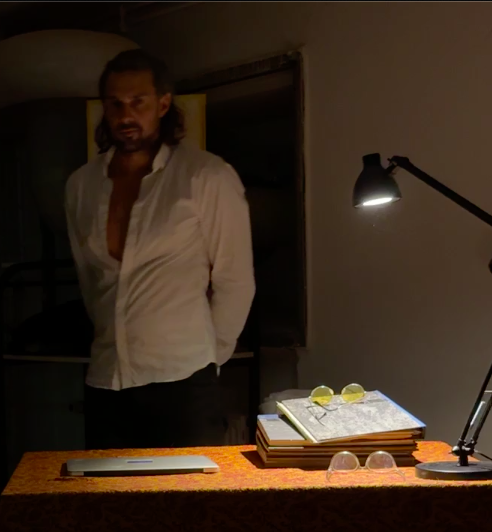
For me, theatre is a way of being. I am less interested in grand stage productions and more excited by how the principles of participatory theatre can can be used for anthropology. I write, produce, and perform theatre as part of my autoethnographic inquiry, and host workshops on how to use theatre tools and games to train researchers to connect theories, emotions, and empirical data through body-focused storytelling.
Scroll down for examples of my recent work.
Theatre From The Field
Theatre from the Field is an ongoing theatre-anthropology project designed to encourage researchers to engage their whole body in intellectual discovery. We host workshops and create performances that centre non-verbal knowledge and tap into the deep emotionality of ethnographic work.
In July 2025 we hosted a 4-day residential workshop in s’ Hertenbosch, The Netherlands, to convene an immersive theatre workshop for fourteen anthropologists. Partnering with Affect Theatre founders Cristiana Giordano and Greg Pierotti, we trained in object theatre, Theatre of the Oppressed, contact improvisation and visual storytelling. To read more about the project, click here.
Theatre from the Field is hosted by the EASA Creative Anthropologies Network, in collaboration with the Vrije Universiteit Amsterdam and SOAS, University of London. It has been funded by the European Association for Social Anthropologists and the Wenner Gren Foundation.
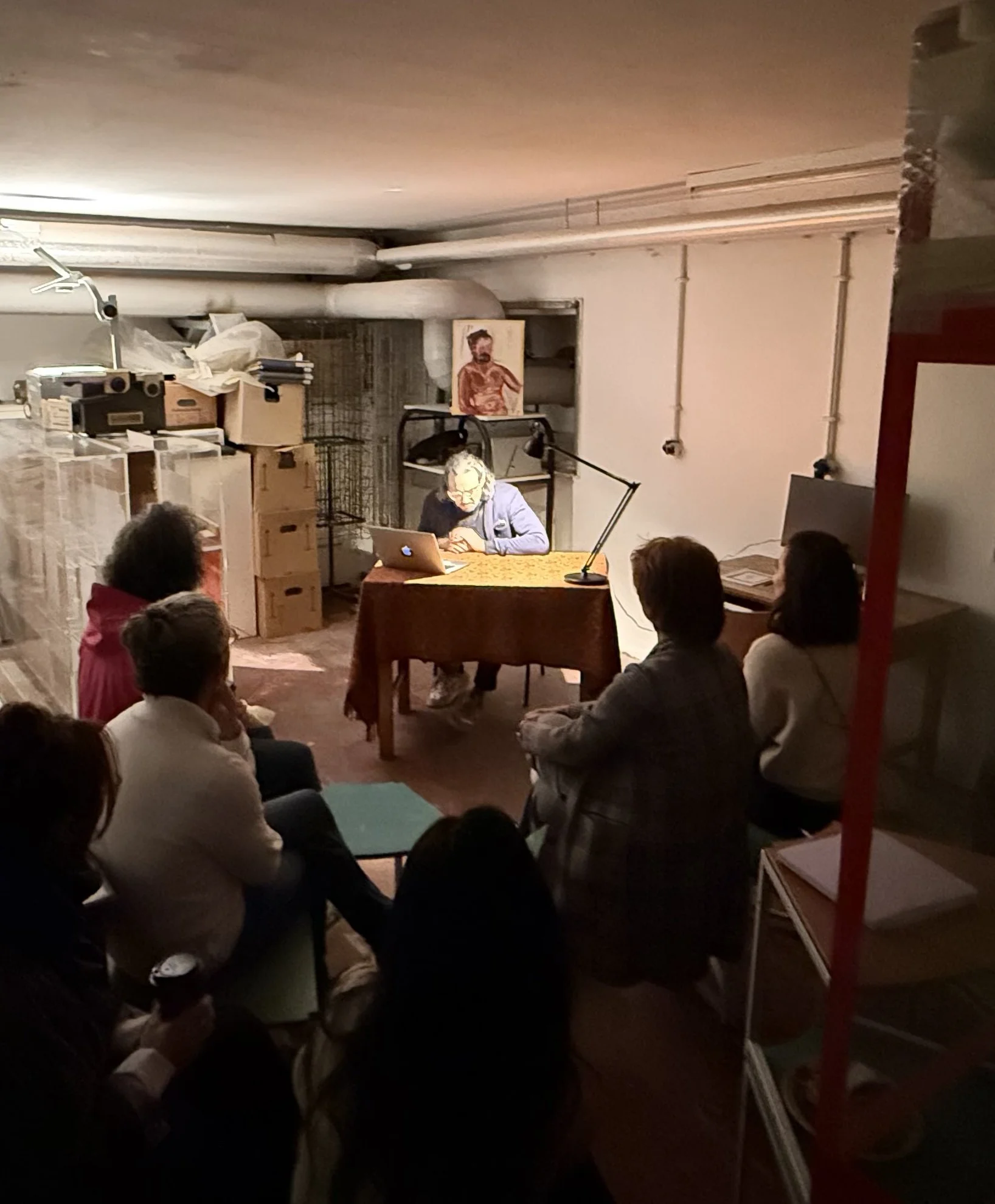
Karel’s Last Tape (2025)
In July 2025 two colleagues wrote a novella in collaboration with Chat GPT. The novella, Lost Predictions, centres on a Karel, a jaded scholar who attends a conference on academic publishing in the era of AI. In October 2025, I was invited to produce a creative response to their novella that would be performed at an anthropology conference in Berlin, the EASA 4th Colleex Workshop on unsettling the anthropological syllabus.
In response, I wrote a pastiche of the Samuel Beckett play, Krapp’s Last Tape. In my place, Karel decides to use AI to help him review his academic career; instead of listening to recordings of his younger self (as Krapp does), Karel accidentally gets AI to speak out his back catalogue in the voice of his ex-wife.
The play is also what I am calling an ‘an autobiographical warning’, a piece of art in which the writer imagines a potential possible future for themselves that they do not want to occur. I wrote and performed the play as autoethnographic reflection on entrepreneurial subjectivity, masculinity, and emotional alienation in academic life. The script has been published by Public Anthropologist, and you can watch a recording of the performance by clicking the button below.
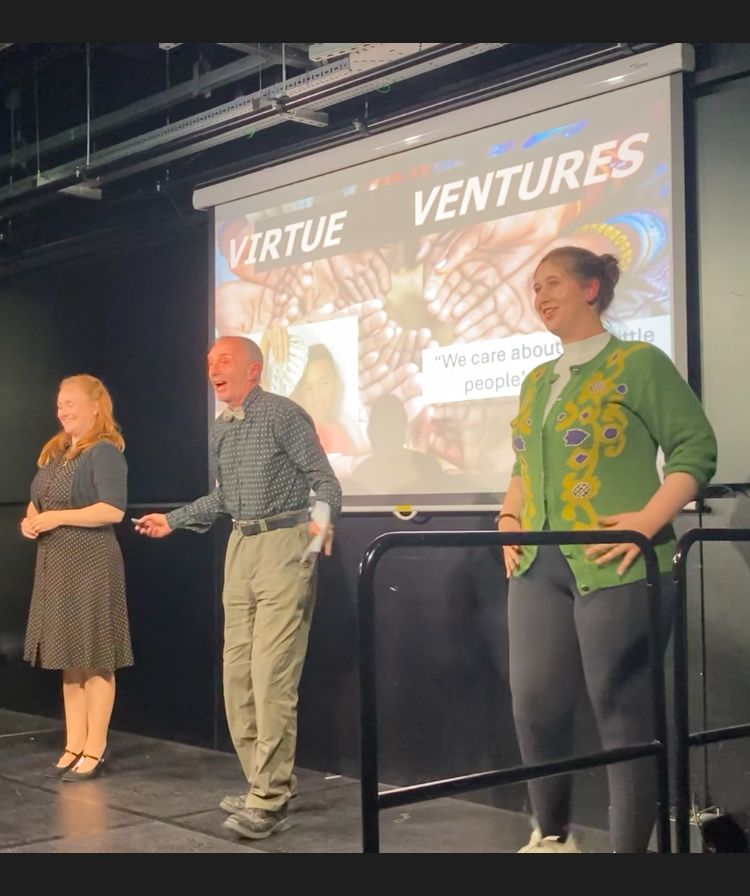
Virtue Ventures (2025)
In May 2025, I became one of five anthropologists selected to take part in the University of Manchester’s Tiny Human Dramas initiative, organised by Meghan Rose Donnelly and Alexandra D'Onofrio.
The initiative is based on the 24-hour-plays phenomenon, where a writer, director, and a group of actors are tasked with devising, producing and performing a play all within 24 hours. In this case, the anthropologist took the place of the writer and shared certain key elements of their ethnographic research with a group of professional actors. The actors and the anthropologist then worked together to develop a performance that articulated key themes, questions, and findings from the research.
I was paired with Hayley ???, ??? ???, and ??? ???, and we created the show Virtue Ventures. The bulk of my ethnographic research focuses on Delhi, Indian education entrepreneurs, and their quest to improve education provision to marginalised children through start-up style social entreprises. Considering the actors lack of familiarity with India, and (as a group of white British people) our collective discomfort representing Indian people on stage, we found a way to communicate the key theme of competitive self-selling through a more absurdist lens.
You can watch a recording of the play here, and read a copy of the script here.
Thicc Description (2024)
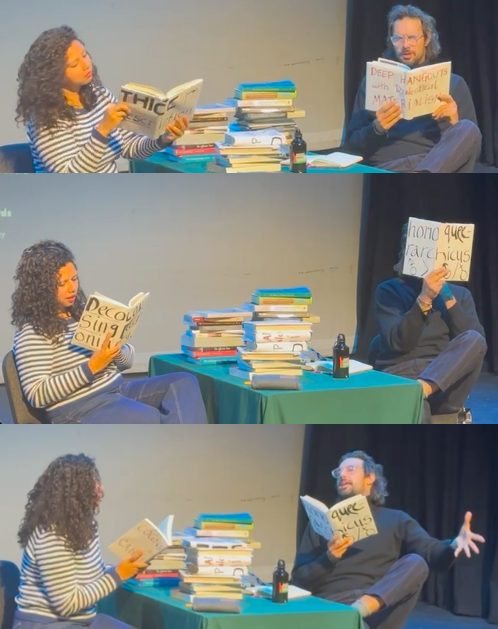
In November 2024 I was invited to perform at the Centre for Creative Ethnography, Queen’s University Belfast, as part of the book launch for A Collection of Creative Anthropologies (2024).
Devised in collaboration with colleague Priyanka Borpujari, Thicc Description is a farce on the performativity of PhD and postdoc competitiveness. In the play, two early-career scholars sit opposite each other, endlessly recommending ‘important’ academic books for the other to read. Each book has a fake name riffing on classic texts and concepts from the discipline of anthropology. ‘Thicc Description, Homo-queer-archicus, Decolonising Decoloniality, and A Thousand Chateaus’ are just a few examples. The play comes to a head as the two scholars pile up the books between then, obscuring their ability to see each other, and indicating their increasing alienation from human contact the deeper they fall into their ‘research’.
The play is autoethnographic in as much as it reflects my own experiences of alienation within an increasingly competitive, individuated university research culture.